

Weekly newsletter: January 20, 2026
Hi, everyone!
January normally feels like 250 days long, but I feel this January is flying by.
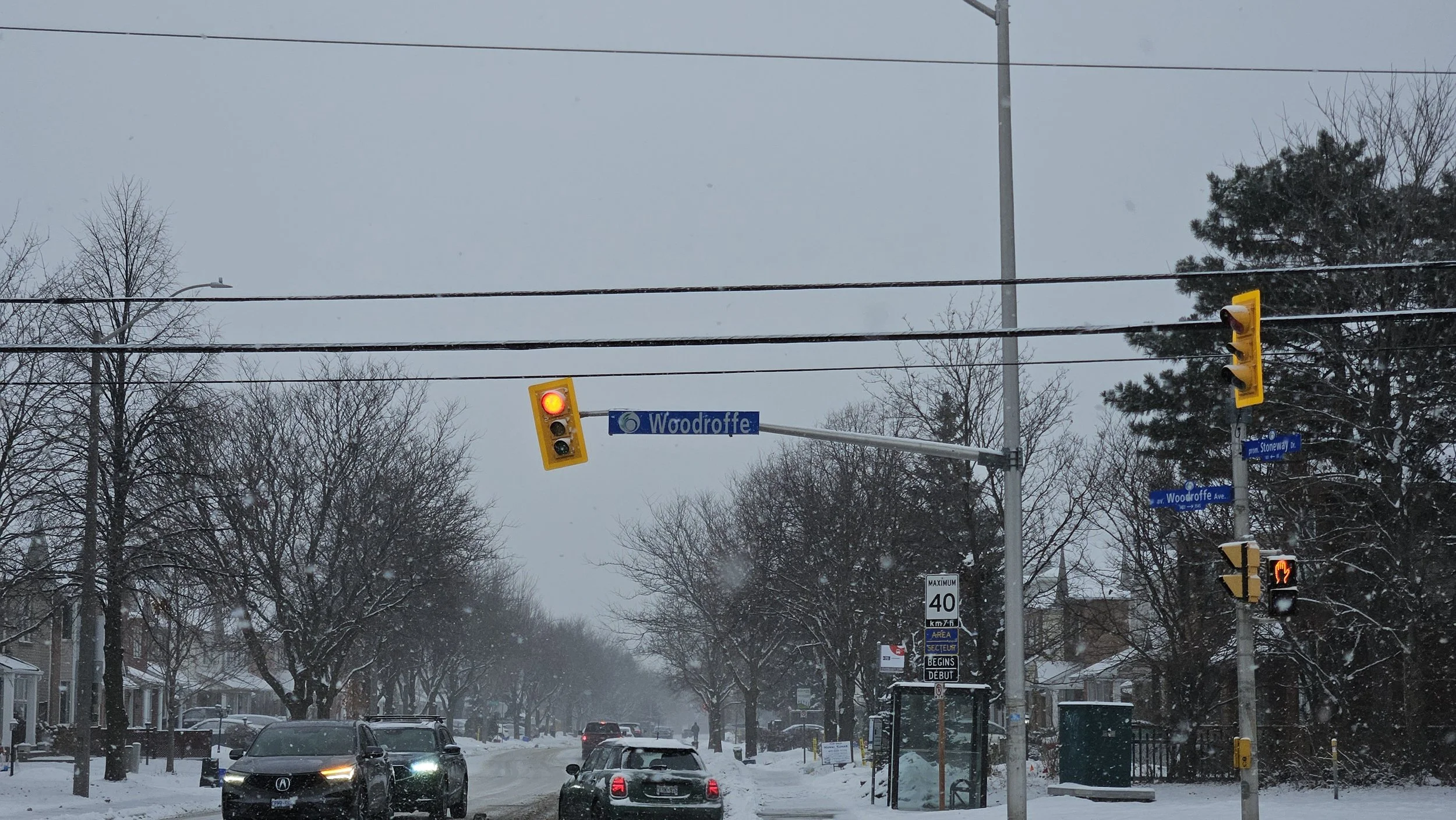
Snowbank removal across the city has begun, but as today is garbage day in Barrhaven East, and with Wednesday’s forecast snowfall and following cleanup, it’s likely no snowbank removal will happen here until Thursday overnight.
In the meantime, I’ve asked public works staff to remove or push back snowbanks obstructing turning sightlines at Fallowfield/Holitman, Greenbank/Highbury Park, and others.
Transit
Temporary long-term trip cancellations reflected in travel planner.
The situation with OC Transpo’s bus fleet continues to deteriorate, as new bus deliveries continue to be delayed.
Regular newsletter readers may feel that I’ve mentioned the fleet situation multiple times over the last two years, and that “once the new buses arrive,” things will improve. That has yet to materialise, and frankly, I know it’s become difficult to believe. I’d probably feel the same if I wasn’t so involved in the situation.
Typically, a city bus has a design lifespan of 15 years, which can be stretched to 18 years with a midlife rebuild (which is the case with some of the oldest buses). Half of our bus fleet has exceeded the 15-year lifespan, with the oldest vehicles now more than 20 years old.
The higher maintenance demands of the oldest buses, the fact it comprises more than half the fleet, and an industry-wide shortage of 310T (truck and coach) mechanics have combined with a management decision in the 2000s to create the current situation.
While delays in new bus delivery and a shortage of mechanics are out of OC Transpo’s control, how we got here started with the poor decision in the 2000s to purchase over 600 buses in two large orders, even though industry best practice is to purchase smaller orders annually.
It was great for a while, as the bus fleet was very new for several years, but unsurprisingly, all those buses aged together. New buses were purchased and delivered in 2019 and 2020 (staggered orders, thankfully).
New buses were not ordered again until early-2023, when the current term of Council (brand new at that time) approved the purchase of 354 e-buses, to be delivered throughout 2024 to 2027. To date, only 41 e-buses have been delivered.
While there have been other issues affecting bus service since 2019, including an operator shortage that was resolved in 2024, the crux of it has been the manufacturer delays which have pushed our oldest buses past their limits.
It appears that the only “penalty” for the manufacturers is that they don’t get paid until the vehicle is delivered, so they are left holding onto the debt of the cost of manufacturing the vehicle (that debt is higher for e-buses than diesel buses), but I will try to find out more.
If anyone has waited for a new car in the last few years, it’s a similar situation, except there isn’t a showroom with ready-built buses for purchase.
As such, OC Transpo has “proactively” (in the weirdest sense of that word) cancelled trips systemwide to reflect the actual level of service they can deliver, including the 18 following trips that service Barrhaven East:
70, 7:27 am from Limebank Station
70, 8:30 am from Fallowfield Station
70, 4:10 pm from Limebank Station
70, 5:15 pm from Fallowfield Station
70, 6:30 pm from Limebank Station
73, 3:08 pm from Fallowfield Station
73, 3:35 pm from Limebank Station
75, 11:20 am from Minto Recreation Complex
75, 11:57 am from Tunney’s Pasture Station
75, 12:27 pm from Tunney’s Pasture Station
75, 1:08 pm from Barrhaven Centre Station
75, 1:27 pm from Tunney’s Pasture Station
75, 1:35 pm from Minto Recreation Complex
75, 3:06 pm from Barrhaven Centre Station
80, 1:30 pm from Barrhaven Centre Station
80, 3:00 pm from Tunney’s Pasture Station
80, 4:02 pm from Tunney’s Pasture Station
80, 5:23 pm from Nepean Woods Station
The cancellations above are reflected in the travel planner. Please note these are trips that are cancelled as there’s no bus for that run at the garage and does not guarantee that unaffected trips will be free from delay or other service issues.
OC Transpo staff say that as the situation improves, mostly through new bus deliveries, some trips will be restored, which will similarly be reflected in the travel planner. These “proactive” cancellations will likely last until the opening of the Orléans LRT extension.
More information will be shared as the situation progresses
Electric bus inquiry
Analysis of OC Transpo staff’s response to my formal inquiry.
Given the issues noted above, one may think electric buses (e-buses) will solve all our problems. At this point, any new bus is a good thing, but it doesn’t resolve my wariness of our aggressive adoption of the e-bus program.
Within the context of ongoing bus manufacturing delays that’s wreaked havoc on OC Transpo’s bus service, since there has been no detailed update of the e-bus program since mid-2023, and given the cost and other implications, I submitted a formal inquiry to staff last September about our e-bus program.
This long read dives into the background, staff’s response, and what’s next.
Background, Toronto as context
The TTC’s Green Fleet Program aims to improve the environmental impact of their bus fleet and is not dedicated exclusively to electrification. An update on the program was provided to their board in July 2025.
The report notes some successes, including emissions reduction and that Toronto now boasts one of the greenest large bus fleets, comprised of clean diesel, diesel-electric hybrid, and battery electric propulsions, in North America.
The report also notes several risks of their e-bus program, including manufacturing lead times, immediate need to replace aging buses, range limitations and compatibility with current service design, charging capacity limitations, workforce requirements, and operational agility in unplanned scenarios.
Left unaddressed, those considerations and risks could negatively impact service delivery and reliability of transit in the City of Toronto.
Most notably, TTC staff recommended the procurement of more hybrid buses for now as insurance against service disruptions due to those risks and related uncertainties.
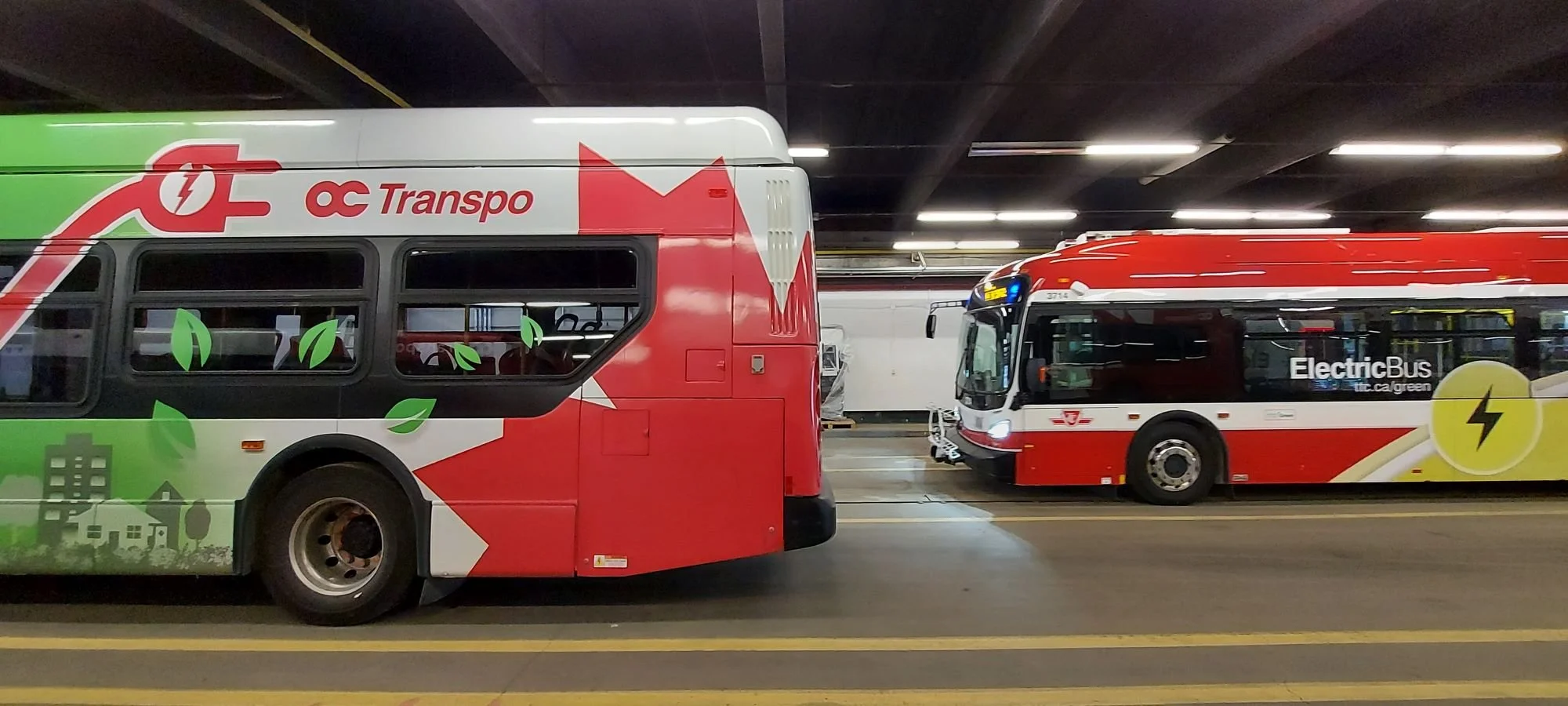
While OC Transpo and TTC both have e-buses from multiple manufacturers, both agencies piloted the same New Flyer XE40 e-bus with the same Siemens motor. However, the TTC’s pilot fleet of 25 New Flyer e-buses is three years older and was tested in an environment more representative of regular operations, as their total e-bus pilot comprised 60 vehicles over three years, compared to our four pilot e-buses over a year and a half.
I have thoughts on how short our pilot period lasted, but that aside, the TTC offers a three-year preview of what we can expect in principle as OC Transpo’s New Flyer e-buses as they grow in fleet size and age.
It is entirely appropriate to consider some of the TTC report in an Ottawa context, as we face similar issues with e-bus manufacturing timelines, an aging bus fleet, and future financial considerations, among others.
Ottawa’s electric bus program
As a reminder, Transit Committee voted in January 2023 to approve a $974 million multiyear program to procure 354 e-buses and related charging infrastructure from 2023 to 2027. That money comprises:
$335 million in municipal funding, equal to the cost of 354 diesel buses
$350 million in federal funding to offset the additional cost of an e-bus compared to a diesel bus
$289 million loan from the Canada Infrastructure Bank for charging infrastructure
OC Transpo is supposed to receive 354 e-buses by 2027. To date, three years after the procurement was originally approved, only 41 have been delivered. While my inquiry is more focused on the e-buses themselves rather than the delivery timeline, it’s still worth noting the situation we’re in as a result, considering the TTC report noted manufacturing timelines as a risk.
My inquiry to staff has 16 questions. They can be categorised into e-bus reliability compared to diesel buses, battery information, and compatibility with current service.
Staff’s full response (PDF) was published mid-December and will be on the agenda of the February Transit Committee meeting (which promises to be a full and lengthy meeting, given other ongoing issues). Not all answers are mentioned or commented on in the following sections.
Vehicle reliability (questions 1, 2, 3)
On reliability, mean distance between failure (MDBF) is a general quantification of a bus’ reliability, as in the kilometres the vehicle can be driven before it is removed for servicing or repairs. The higher the MDBF, the better.
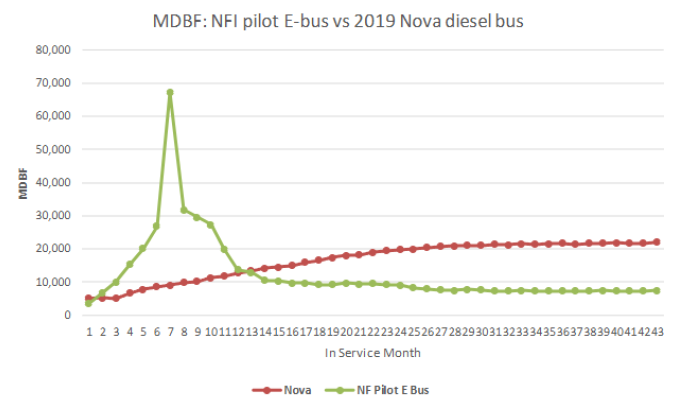
OC Transpo’s NovaBuses entered service in 2019 and managed an MDBF around only 5,000 kilometres in their first four months in service but climbed steadily to 10,000 kilometres by month eight in service, and 20,000 kilometres by year two, where it’s remained since.
On the other hand, the pilot e-buses started with excellent MDBF, peaking at just over 30,000 kilometres in their eighth month in service (I’m discounting the outlier of 70,000 kilometres in month seven). However, it steadily declined to just under 10,000 kilometres by its second year in service, where it’s remained since.
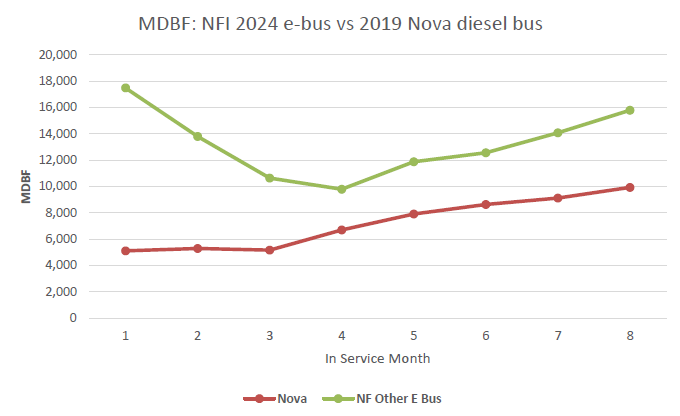
Meanwhile the newer e-buses (the ones with the white destination signs), at about eight months in service, have an MDBF averaging around 16,000 kilometres. In the pilot fleet, eight months was where the MDBF began to decline, so I’m interested in more recent data for the newer e-buses once that is available.
It’s also worth noting that MDBF does not capture the severity of the failure. Accordingly, I also asked staff for the average length of time the buses had to be removed from service for propulsion-specific defects. The more downtime hours required per work order, the more time the bus is not in service.
NovaBuses averaged 77.5 downtime hours per work order, the pilot e-buses averaged 95.3, while the newer e-buses are averaging 52.3. Similarly, I’m interested in more recent data for the newer e-buses.
Interestingly, most of the TTC’s 25 New Flyer pilot e-buses have been sidelined since late-2025, though I haven’t been able to find a reason (I’ve reached out to a contact there).
Service design compatibility (questions 8 to 11)
E-buses have up to 300 kilometres of range on a full charge. To account for unplanned scenarios such as detours, service delays, and bad weather, e-buses are assigned to runs of up to 235 kilometres before returning to the garage to charge.
For comparison, a NovaBus with a full tank of diesel has a range of 1,031 kilometres and can stay in service for up to 24 hours (the longest run I’ve ever seen is 21 hours).
A run is a series of trips strung together to create the operator’s shift. Some runs have multiple operators with changeover/relief points on route or at the end of a trip.
During the autumn service schedule, 43 per cent of weekday runs, 55 per cent of Saturday runs, and 60 per cent of Sunday/holiday runs were longer than 235 kilometres and therefore not compatible for e-buses.
OC Transpo staff have stated changes to service hours and vehicle requirements are not required for the current fleet composition and will continue to be unnecessary within the current order of 354 e-buses, as it comprises just less than half the fleet.
However, when e-buses make up 50, 75, and 100 per cent of the fleet, as is the City’s current goal by 2046, it’s likely additional buses (and therefore operators) will be needed to deliver the same level of service. Staff say there will be a comprehensive study when those fleet compositions are reached.
What I foresee is additional resource requirements for weekend, holiday, and reduced service period (eg. Christmas week) runs, as those runs are designed to be longer to use fewer resources.
For reference, the TTC noted the bus-to-bus replacement ratio to electric is 1.05, meaning 1.05 e-buses will be needed to replace each diesel or hybrid bus to meet current service levels there. It’s not an insignificant number with Toronto’s fleet of over 2,000 buses.
The batteries (questions 4, 5, 6)
OC Transpo staff note the real-world lifespan of an e-bus battery aligns with the manufacturer warranty, which is 12 years for the New Flyer e-buses. New Flyer estimates the battery will retain at least 70 per cent of its original capacity by the bus’s 12th year in service.
Per staff, the four pilot e-buses (all five years old) have showed no observable signs of battery degradation, though it should be noted these buses are currently affected by a recall from Transport Canada, which has temporarily limited their maximum charge to 75 per cent.
Staff currently have no plans for the batteries’ end-of-life, which is fair, considering their 12-year expected lifespan.
Charging infrastructure (questions 13, 14)
Upon completion, ongoing construction works at the St-Laurent bus garage will produce 354 charging stations for all 354 e-buses in the multiyear order. According to staff, the timing of charging procurement and installation is aligned with each tranche of the e-bus order.
The TTC has noted their charging infrastructure has fallen behind e-bus deliveries, which has required additional staff time to rotate buses so they can be charged. Among the risks noted in their report was further delays to a point where e-buses in the fleet and charging stations are so misaligned, some e-buses will have to sit in storage.
One advantage Ottawa has over Toronto in this scenario is that all our e-buses are at one garage, whereas the TTC has spread them out at multiple garages. If charging infrastructure falls behind here, the bus shuffling will require fewer staff to complete (but still require extra staff time).
What’s the point?
I’ve always been cautious of the City’s aggressive adoption of the e-bus program, after all, I was the only Councillor on Transit Committee who voted against the program in 2023.
The previous City Council approving a pilot was a good idea, but I am forever baffled by their later decision that all future bus procurements would be electric… months before the first pilot e-bus was delivered (that was while I was an employee at OC, so I wasn’t allowed to express that point of view at the time).
As mentioned earlier, the TTC piloted 60 e-buses from three manufacturers for years and still opted to purchase more hybrid buses next year as a transition technology while they decide on fully committing to electric.
Within the context of ongoing bus manufacturing delays that’s wreaked havoc on OC Transpo’s bus service, since there has been no detailed update of the e-bus program since mid-2023, and given the cost and other implications, the inquiry became necessary to help reevaluate Council’s past e-bus decisions.
At the September Transit Committee, I actually submitted the formal inquiry concurrently with a motion directing OC Transpo to consider all propulsion options, including diesel, in future bus procurements. As there are currently no market tested articulated e-buses available in North America, the motion also reopens the option to procure higher capacity buses. Committee unanimously adopted the motion in November.
Sure, it can be seen as environmental backtracking, but putting service first to attract people to transit (let alone keep the existing ridership) is equally beneficial.
The inquiry and staff’s response will be listed on the agenda for the February Transit Committee meeting.
Bite-sized updates
Sorted alphabetically!
Beatrice/Queensbury bus shelter – Delayed to the spring or summer. See explanation from December and update from last week.
March Break camp registration – Residents may now browse March Break camp activities at register.ottawa.ca↗. Registration opens tonight at 9:00 pm.
Fallowfield/Transitway – The traffic signals at Fallowfield/Transitway are intermittently cycling on their own (instead of changing for Transitway traffic only). City staff will investigate all detection components as the fault has happened a few times over the last year.
Spring recreation registration – Residents ay browse spring recreation activities starting January 27 at register.ottawa.ca↗. Registration on February 10 at 9:00 pm for aquatics, February 12 at 9:00 pm for all other activities.
Vacant unit tax – The 2026 vacant unit tax declaration portal is now open. Homeowners may complete their declaration through their ServiceOttawa account↗, at Ottawa.ca/VUT↗, by calling 613-580-2444, or in person at Ben Franklin Place or City Hall. Letters with access codes will be mailed out next week.
Waste collection – Circular Materials has corrected the recycling collection information in their map to match the City’s collection calendar. For reference, the remaining collection days in January are:
Tuesday, January 20 (today): garbage, blue, green, yard waste
Tuesday, January 27: black, green, yard waste
That’s all for this week! Thanks for your continued readership.
-Wilson