
All About ditches: Key information about maintenance responsibilities and alteration requirements
What are ditches and why do they matter?
Ditches are narrow, excavated channels in the ground designed to collect and slow the flow of surface water during rainstorms and spring snowmelt. They are an essential part of the community’s drainage system, helping water move safely away from roads, properties and low-lying areas toward downstream watercourses.
When they are functioning properly, ditches collect and convey water. They can also slow the flow of surface water, promote infiltration, and promote filtering of runoff which helps reduce flooding, erosion and damage to both private and public infrastructure.
Did you know? Many ditches are designed to temporarily hold water before it drains away. This means that ponding is normal, especially after heavy rainfall, during spring melt, or in flatter areas where water infiltrates the ground more slowly. A slower flow reduces the likelihood of flooding and prevents erosion which extends the life of the ditch infrastructure.
Why are they important?
By controlling how water flows and drains, ditches help:
Prevent flooding: Ditches are designed to catch and temporarily hold water so it can slowly soak into the ground, reducing localized flooding.
Improve road safety: Keeping water off road surfaces helps prevent erosion, pooling, and icy conditions.
Protect property and infrastructure: Properly maintained ditches help protect both public roads and nearby private property from water damage.
Lower costs: ditches are generally less expensive to build, maintain and repair than underground sewers.
Support environmental health: Ditches can improve water quality by slowing water flows and allowing sediment to settle. Vegetated ditches can also provide habitat and reduce erosion.
Myth: Drains are better and more efficient than ditches.
Fact: While both help manage water, ditches and drains are designed for different situations, and one is not inherently better or more efficient than the other. Each plays a role depending on local drainage needs and land use.
Municipal drains are engineered systems formally designed and constructed under Ontario’s Drainage Act↗.
Ditches, on the other hand, are referred to as “nature’s drainage.” Think of them as informal water channels that work with natural landscape features to move water safely and effectively.
By working with the natural shape of the land, rather than relying on enclosed infrastructure, ditches provide a practical and adaptable way to manage water:
They may be natural or dug out by hand or using equipment
They direct rain and snowmelt away from roads and nearby properties
They can often be maintained or adjusted without major infrastructure changes
What is ditch maintenance?
Together, ditches and storm pipes form a larger drainage system that manages surface water across the City. Over time, these systems need regular upkeep to ensure water flows where it is intended, protecting properties, roads and the surrounding environment.
Ditch maintenance needs are identified through service requests, routine visual inspections and during spring flooding response.
Ditch maintenance may include:
Clearing debris and sediment to help water flow freely
Managing vegetation to prevent overgrowth from restricting water flow, while allowing water to move at a controlled and steady pace
Flushing culverts to remove blockages so that water can flow
Regrading the ditch to restore its slope and shape to its original design
Thawing culverts in cold conditions to allow flow
Who is responsible for what?
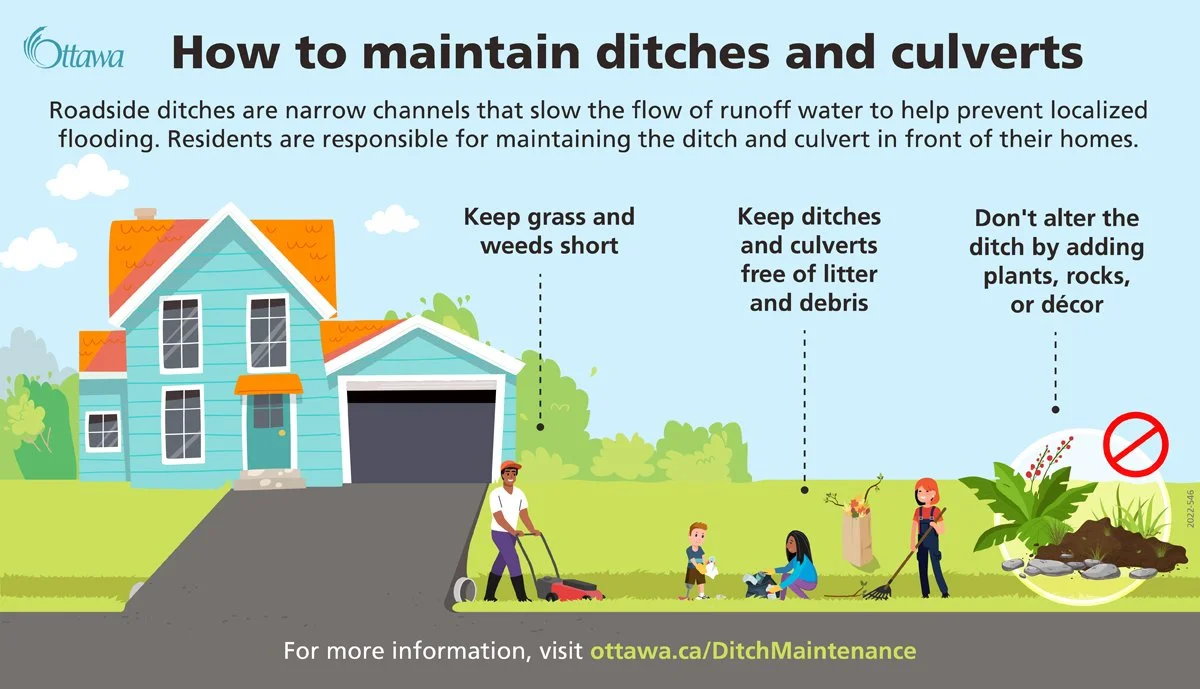
Ditch maintenance is a shared responsibility between property owners and the City. Responsibilities vary depending on where the ditch is located.
Under the City’s Use and Care of Roads By-law↗, property owners are responsible for general maintenance associated with their property which includes certain ditch-related tasks. Failing to meet these requirements may result in enforcement action.
To help you understand who is responsible for what, here is a summary of ditch maintenance responsibilities.
In urban/suburban/rural subdivisions
The property owner is responsible for:
Routine maintenance and flushing of culverts
Removing debris
Removing root infiltration from private trees
Maintaining the boulevard such as grass, weeds and debris
Replacing deteriorated or dam
The City of Ottawa is responsible for:
Re-establishing the grade and slope to the original design to maintain positive drainage, as part of a larger maintenance program
Flushing identified culverts in the larger maintenance program to remove silt and sand
In rural areas (not part of subdivision)
Due to safety concerns, rural roadside ditches that are not in subdivisions receive additional City maintenance.
Property owners are responsible for:
Routine maintenance and flushing of private approach culvert
Replacing deteriorated or damaged culverts
The City of Ottawa is responsible for:
Flushing cross culverts
Removing debris
Re-establishing the grade and slope to its original design to maintain positive drainage, as part of a larger maintenance program
Flushing culverts to remove silt and sand, as part of a larger maintenance program
Cutting grass and weeds twice a year (spring and late summer)
How the City accesses private property
In some cases, the City has easements for ditches located on private property↗. An easement is a legal agreement that sets out the terms and conditions under which the City may access private property to inspect or maintain ditches that service City infrastructure.
While an easement gives the City the right to access the ditch, it does not automatically mean the City is responsible for maintenance at that location. General maintenance is the responsibility of the property owner, similar to road ditches. On a case by case basis, the City will determine maintenance opportunities as there are a variety of factors that affect drainage conditions differently depending on the location..
What can you expect?
Maintenance timelines
Ditch maintenance typically occurs seasonally, with increased activity in spring and fall. Residents may notice crews and equipment working along roadsides or in known drainage areas. Some short-term disruption is normal while this work is completed.
Service priorities
Ditch maintenance provided by the City is categorized into three categories:
Priority A: obstructed drainage causing flooding that poses an immediate safety hazard
Completed within 4 hours
Priority B: partially obstructed drainage causing intermittent water backups that do not pose a safety hazard, but that over extended periods of time could impact the quality of the infrastructure
Completed within 30 days
Priority C: some deterioration of the drainage system, but no safety hazard
Added to ditch maintenance list to be completed as soon as practicable
Beyond routine maintenance
The City has a Ditch Renewal Program. This program focuses on rehabilitating existing roadside ditches, replacing culverts, and ensuring proper drainage flow. These efforts are delivered through capital projects, addressing needs that go beyond routine operational maintenance.
To alter or not to alter: Understanding ditch alterations
Altering a ditch, such as changing its slope, location, appearance or function, can disrupt water flow and lead to localized flooding or increased maintenance issues if not completed with proper technical analysis or design guidelines.
Even a change made on your property can affect the drainage system for your neighbour.
To alter a ditch legally, property owners must either submit a Local Improvement request or obtain a Planning Agreement.
Local Improvement process
A Local Improvement process is a provincially regulated process to request new infrastructure, such as stormwater pipes where none exist.
The process considers infrastructure as part of a broader system and requires:
Support from at least three properties
Support from at least 67% of the neighbourhood
The City covers the costs of the engineering study, while construction costs are shared among benefiting property owners.
For more information, please visit the Local Improvement Process page↗ on Ottawa.ca.
Planning Agreement
Ditch alterations may also be pursued through the planning and development review process using a Planning Agreement.
Overview of the process:
Property owners first consult with the City of Ottawa
Required engineering studies and supporting information must be submitted
All costs associated with the project would be the responsibility of the property owner(s).
For more information, you may contact Development Agreement Process group by email at drengrural/epaingrural@ottawa.ca.
How can you help?
Keep ditches clear: do not dump leaves, grass clippings or debris
Do not alter ditches without approval
Report any issues or concerns to the City when you see them.
Regular ditch maintenance protects homes, properties and the environment. By working together and following established guidelines, we can ensure our drainage systems continue to service the entire community effectively.
Who to contact?
Do you have a question or need to report an issue?
Submit an online service request at Ottawa.ca/311↗
Call 3-1-1 or 613-580-2400 (TTY: 613-580-2401)